SIS and LMS for International Baccalaureate Schools

Records, Planning, Criterion Assessment and Reporting for PYP, MYP and Diploma Schools

The SIS and LMS Your IB Programme Runs On

SCL is a student information system and learning management system built for International Baccalaureate schools. Each school division is set to its own academic system, IB PYP, IB MYP or IB DP, and the unit planners, gradebook and report cards change shape to match it. Teachers, coordinators and heads of school all work inside the same installation.The IB material is already loaded. The 16 key concepts, 6 global contexts, 6 transdisciplinary themes and the 10 learner profile attributes ship as managed catalogs, subject criteria fill from the MYP packs in one click, and Approaches to Learning seeds from ready-made MYP, PYP and Diploma taxonomies.Coordinators get the answer they normally assemble by hand: which criteria have been assessed, which concepts no unit has addressed yet, and which students are not ready to report on, while the term is still open.
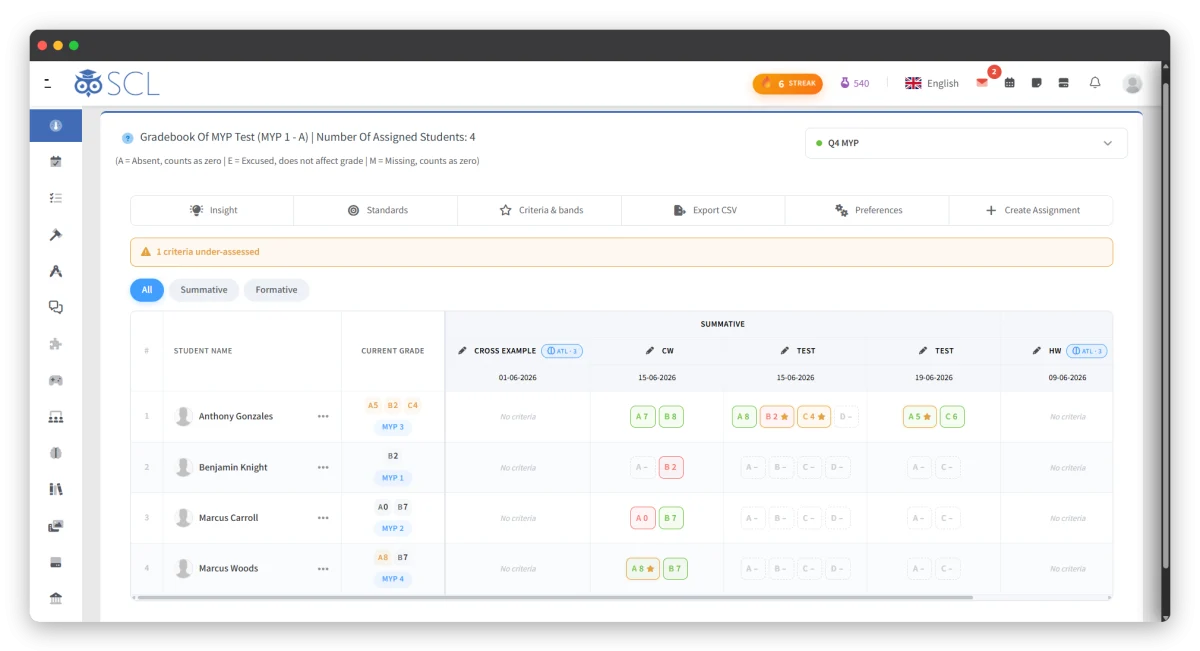
The SCL gradebook for an IB MYP class, where summative tasks are scored against criteria A to D and each student carries a current MYP grade badge beside their criterion levels.

Your School, in IB Terms

01

Divisions by Programme

Each school division is set to its own academic system, IB PYP, IB MYP or IB DP, and only then do the programme's fields appear. One installation runs a Primary Years section beside a Middle Years and a Diploma one.
02

IB Grade Boundaries

An MYP division's grading scale carries an IB Grade with its own boundary minimum and maximum, so criterion totals convert to a 1 to 7 instead of a percentage. Administrators edit those boundaries per division and academic year.
03

Report Cards per Programme

Report cards have their own layouts for IB PYP and IB MYP, each printing the grade conversion table beside the results. Criterion levels are frozen onto the card when the quarter closes, so a later edit cannot rewrite what was reported.
04

Carried Into Next Year

Promoting to a new academic year copies each unit in full, its framing, concepts, inquiry lines and resources, and subject criteria travel with their strands. An IB school does not rebuild its programme from scratch each year.

Planning the Way IB Plans

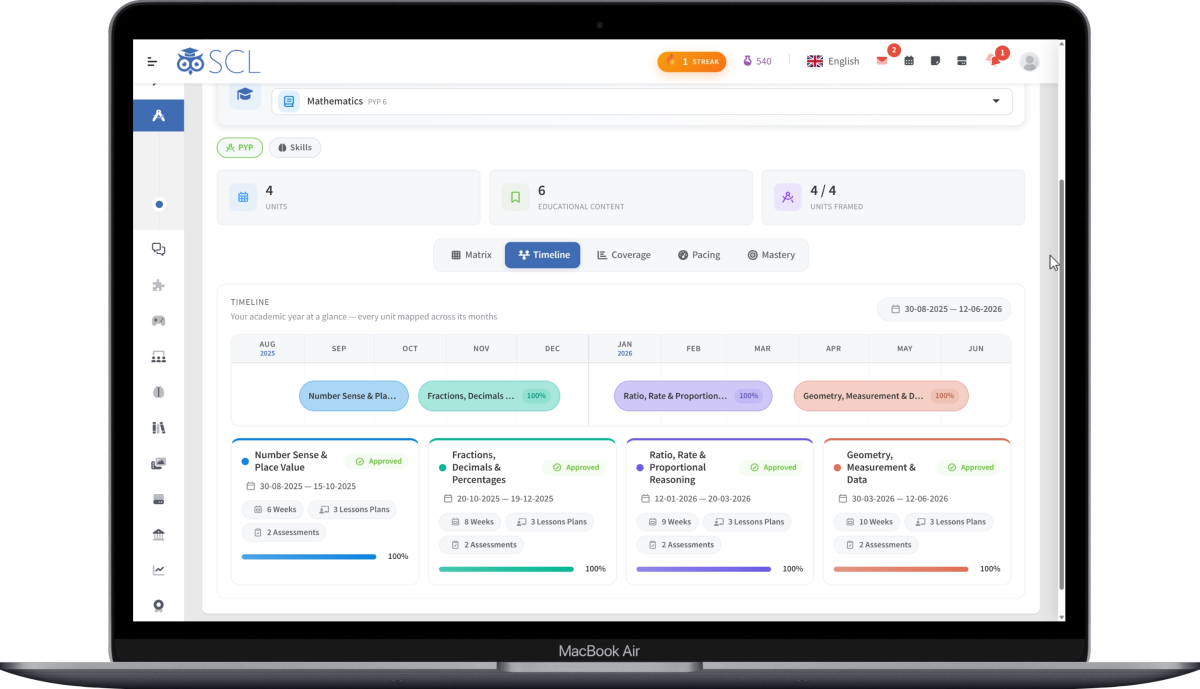
The SCL Unit Planner timeline, where a coordinator sees every Mathematics PYP unit mapped across the academic year, each unit card showing its weeks, lesson plans, assessments and approval status.
05

The Conceptual Catalog

Units in the Curriculum Center draw from managed catalogs rather than typed-in text: all 16 key concepts, 6 global contexts, 6 transdisciplinary themes and the 10 learner profile attributes, preloaded. Schools rename, reorder, retire or add their own.
06

A Planner That Follows the Programme

A PYP unit asks for its central idea, transdisciplinary theme and lines of inquiry. An MYP unit asks for a statement of inquiry, key and related concepts and a global context, while a division outside the IB sees none of it.
07

Statement of Inquiry Composer

The unit editor builds a statement of inquiry from the concepts and global context already chosen, following a guided template. Teachers write a defensible statement in a minute rather than facing an empty box.
08

Inquiry Questions

Every line of inquiry carries its questions underneath, each tagged factual, conceptual or debatable. Conceptual coverage then names anything a subject has not addressed yet, so gaps surface while the year is still open.

Assessed Against Criteria

09

Criterion Based Grading

Switch a division to rubric grading and its subjects grade against criteria instead of percentages, each criterion carrying a code, a maximum score and its strands. The gradebook then scores by criterion for every class in that division.
10

The MYP Criteria Library

Nine MYP subject packs ship with the system, from Sciences and Mathematics to Language and Literature, each carrying criteria A to D with strand wording per MYP year. Import them for one subject, auto-map a whole division, or reset to the IB default.
11

Band Descriptors

Achievement bands are written once for a division and every criterion in it reads the same wording, with MYP on five bands, PYP on four levels and Diploma on 1 to 7. Teachers open the descriptor while scoring, which is what keeps two markers aligned.
12

Best-Fit Levels

On summative tasks in an MYP division, a teacher flags the score that represents the student's real level for each criterion, and the report card takes that one rather than an average. SCL can suggest the whole best-fit set from recent summative work, leaving flagged scores untouched.

What the Coordinator Sees

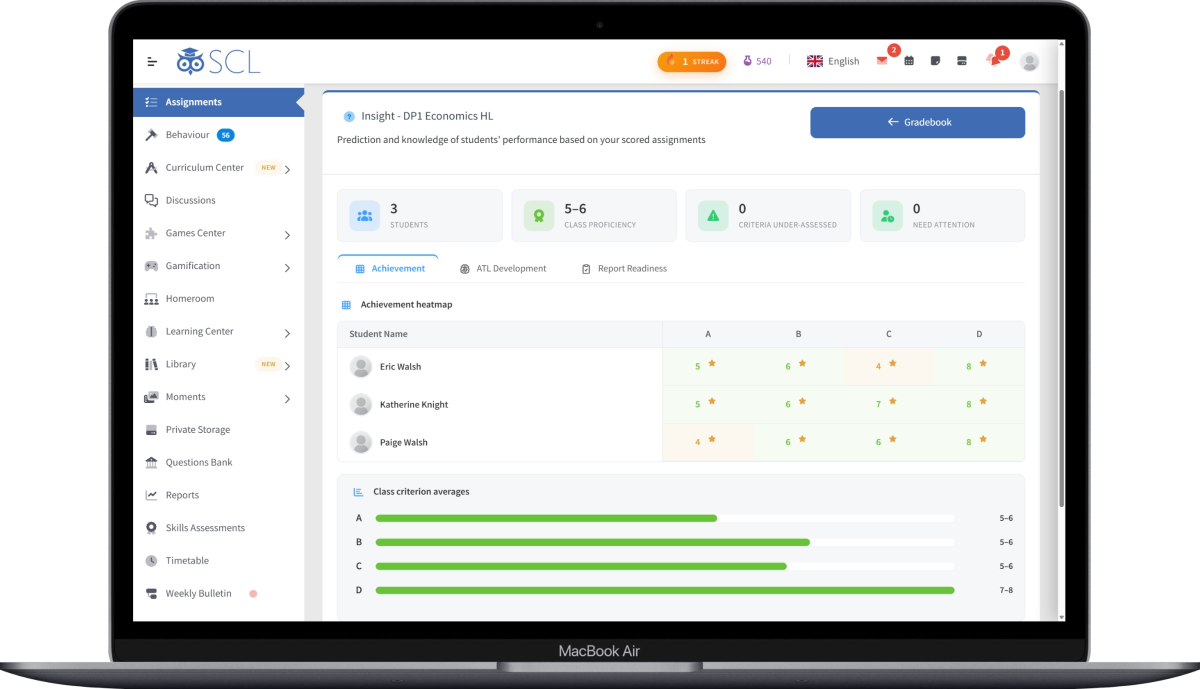
The SCL gradebook Insight for an IB Diploma class, showing an achievement heatmap of each student's level per criterion, class criterion averages, and tiles for class proficiency and criteria under-assessed.
13

Criteria Assessed

SCL counts how many published summative tasks have assessed each criterion and flags any falling below the division's minimum, which defaults to two. Under-assessed criteria surface while there is still term left to fix them.
14

Coverage Maps

The planner's coverage view reads standards, skills and concepts, mapping each against an Introduce, Develop and Master progression. It names what was never taught, what was over-emphasised, and anything mastered without an introduction.
15

ATL Development

Gradebook Insight charts a class's Approaches to Learning emphasis across Communication, Social, Self-management, Research and Thinking. ATL skills are tagged as evidence of growth rather than graded, so the chart shows what the teaching actually developed.
16

Report Readiness

Before a term closes, coordinators see how many students are ready to report on, which criteria have no best-fit flagged and which summative work is still ungraded. Nothing is discovered on the day report cards are due.

See It Live

See SCL Set Up for Your Programme

Walk through a unit framed by its statement of inquiry, an MYP gradebook scored against criteria, and the coverage and report readiness views a coordinator uses before term closes.