Setting Your Own Grading Scales, Weighting Assessment Types, and Scoring IB Criteria in One Gradebook

One Gradebook for Every Way You Grade

SCL Grading gives every school division its own grading scale, assessment types and weights, so a school running more than one curriculum marks each programme the way that programme expects. Administrators and coordinators set the rules once for the academic year, and every teacher works inside the same gradebook.Teachers enter marks in one grid, students down and assignments across, grouped under the assessment types you defined. Percentage divisions get a live earned grade the moment a score lands. IB divisions score against criteria instead, with band descriptors, best-fit levels and a current MYP level calculated by the same rule the report card will use. An assignment can also carry the standards, subject objectives and ATL skills it assesses, so the marks a teacher enters here are what fills the coverage and mastery views back in the Curriculum Center.Parents and students read the same marks in the web portal and the mobile app, with visibility you control globally, per division and per student. Your office keeps period locking, unlock windows and central exam control, so grades stay consistent across every teacher and nothing reaches a family before you are ready.

Grading Scales and Assessment Types

01

Grading Scale

Each division gets its own grading scale for the academic year: achievement labels, score ranges, colours, GPA points and IB boundaries. Administrators set honours levels and AP weighting per division, so one school can run several systems at once.
02

Assessment Types

Build the catalogue of assessment types your teachers mark against, tagging each as formative, summative or an end of academic period exam. Each type carries its own colour and can sit in a group, so every gradebook column says what kind of work it holds.
03

Weights Per Subject

Every subject decides what each assessment type is worth, and SCL stops the total going past 100 percent. Subjects that grade differently from term to term set their own weights per academic period, and admins copy a set to many subjects at once.
04

Grading Settings

One page sets the rules the whole school grades by: the failing grade threshold, eight rounding options, how GPA is weighted and the thresholds grace marks work from. Set it once and every division calculates the same way.
Gradebook Percentage

The Teacher's Gradebook

05

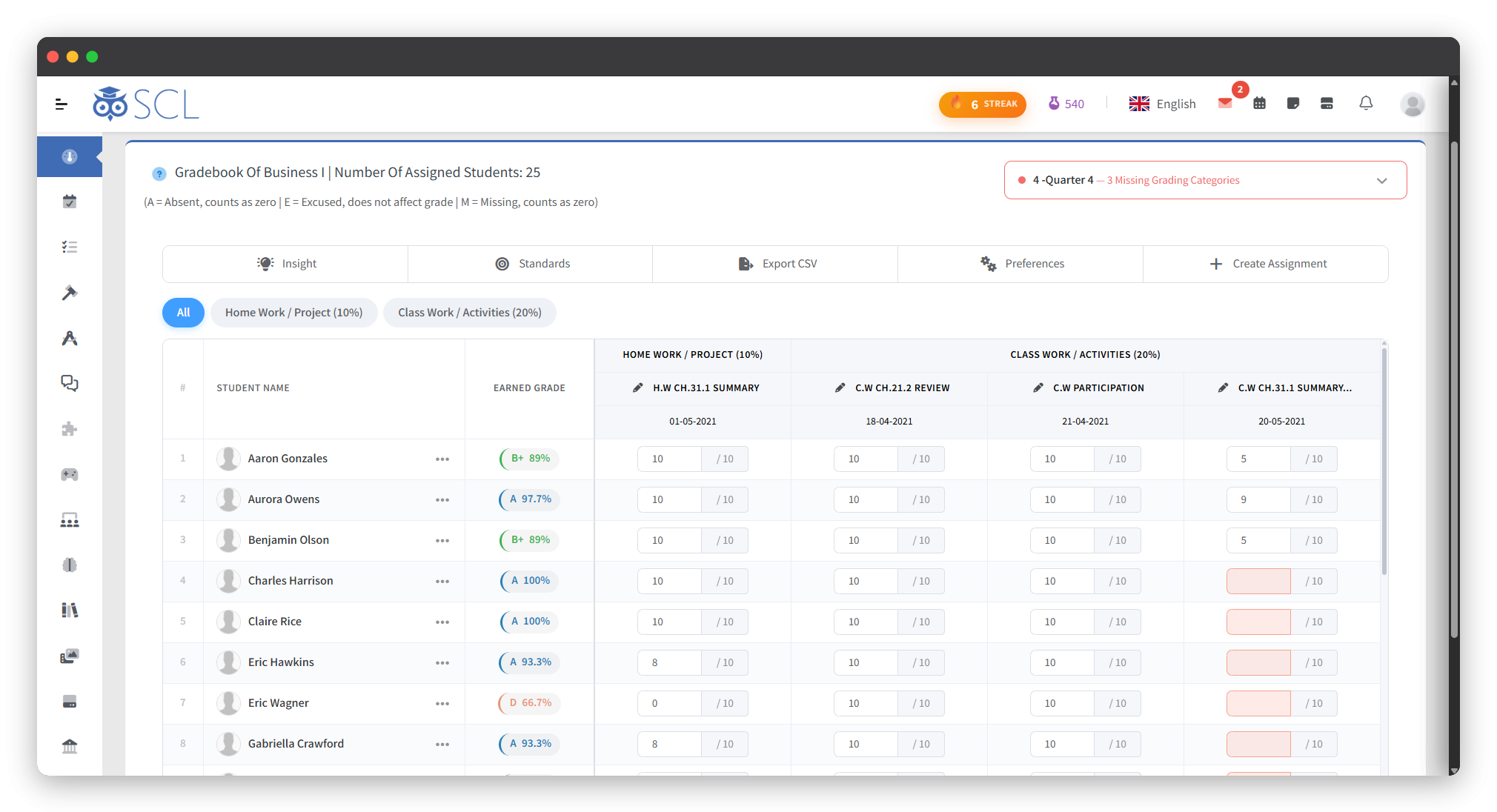
The Gradebook Grid

Students run down, assignments run across, and every column sits under the assessment type it belongs to. Marks save as the teacher types, and the same gradebook works from a phone browser, so scores go in between lessons instead of after them.
06

Absent, Excused and Missing

Any cell takes A for absent, E for excused or M for missing instead of a number. Excused work drops out of the calculation entirely rather than counting as zero, so a student is never marked down for an absence the school approved.
07

Marks Without Retyping

Interactive assignments correct themselves and post their scores straight into the gradebook. Teachers mark longer work question by question and attach feedback as they go, so nobody copies a number from one screen to another.
08

The Live Earned Grade

SCL weights every assessment type, applies your rounding rule and shows the earned grade the moment a mark lands. Teachers see class averages, medians and the students flagged at risk beside it, and can export the whole gradebook to CSV.

Criterion Grading for IB Divisions

09

Subject Criteria

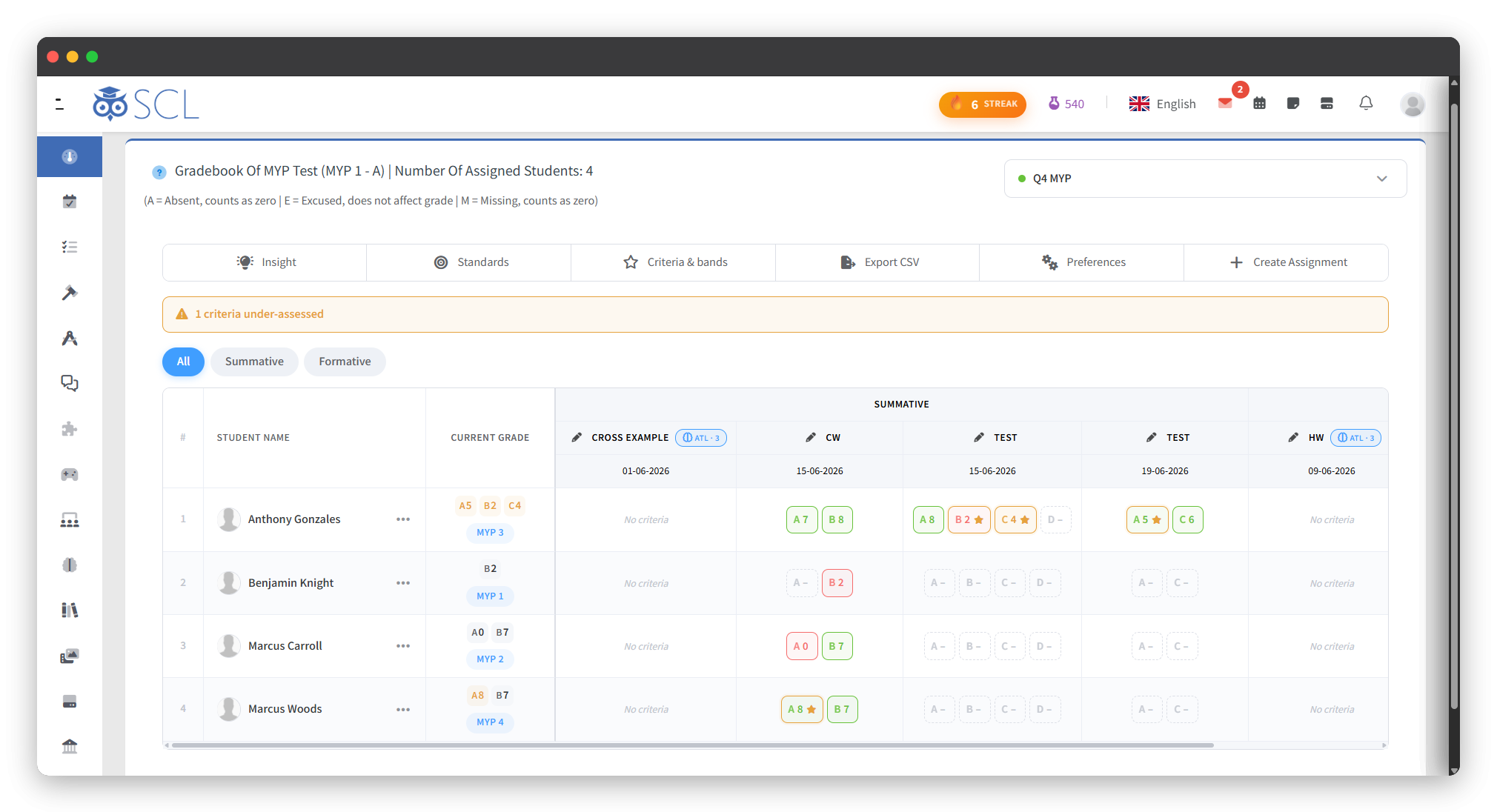
Switch a division to criterion based grading and its subjects grade against criteria instead of percentages, each with a code, a maximum score and descriptive strands. Import the IB MYP criteria packs, or write your own for any programme.
10

Band Descriptors

Write the achievement bands once for the whole division and every criterion in it reads from them. Teachers open a band popover while scoring, so two teachers marking the same criterion are working from identical wording.
11

Best-Fit Levels

A teacher stars the one score per criterion that represents the student's real level, and that is the score the report card takes. SCL can suggest the best-fit set from the most recent summative work, leaving anything starred by hand untouched.
12

Criterion Coverage

SCL counts how many published summative tasks have assessed each criterion and warns coordinators when one falls below the division's minimum. Under-assessed criteria surface while there is still term left to fix them.
MYP Gradebook

Oversight and Access

13

Locked Periods and Unlock Windows

Teachers can only change marks inside the current academic period for their own groups. When a correction is needed, admins open a dated unlock window, narrowed to particular assessment types if they choose, then let it close on its own.
14

Examination Control

Admins create one end of period exam across every teacher group of a subject and enter the marks centrally, with teachers locked out of those cells. A single switch publishes the whole period's results at once.
15

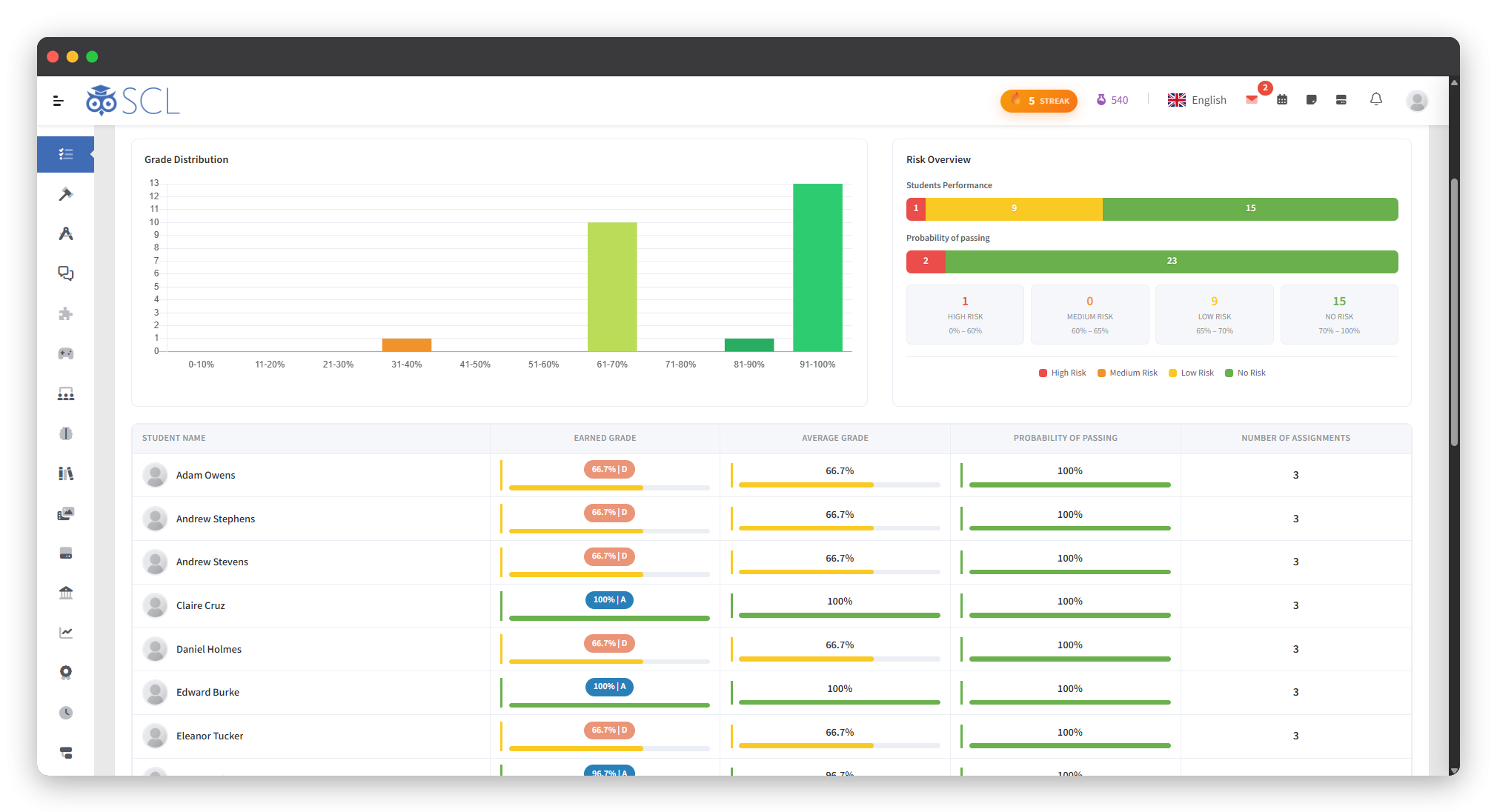
Insight and Rubric Insights

Every teacher gets a read on the class: grade distribution, highest and lowest, and the students SCL flags as at risk. IB divisions add an achievement heatmap, criterion averages and a report readiness check before the term closes.
16

What Families See

Parents and students open the gradebook in the web portal and the mobile app, read only and always current. You decide who sees it with global, per division and per student switches, and unpublished assignments stay hidden until you are ready.
SCL grade-analytics dashboard where teachers and coordinators track class grade distribution, a high-to-no-risk student overview, and each student's earned grade, average and probability of passing.

See It Live

See How SCL Fits Your Grading Policy

Walk through the gradebook, the criterion screens and the locked marking periods with our team, and see how percentage and criterion grading sit side by side in one system.