Curriculum Center

Frameworks, Standards, IB Concepts, Unit and Lesson Planning, Coverage and Mastery in One Place

Plan the Curriculum, Then Prove It Was Taught

Curriculum Center is where a school defines its curriculum and plans its teaching. Administrators build the catalogs the whole school works from: frameworks, standards, subject objectives, ATL skills and the conceptual items units draw on. Heads of department design the units; teachers write the lesson plans that deliver them.A unit carries its Understanding by Design framing, the standards it aligns to and its lines of inquiry. An IB division adds key concepts, global context and the statement of inquiry. A standard subject sees none of that, because fields a curriculum does not use never appear at all.Because planning and assessment share the same standards, the planner can show what was covered and what was not. Coverage names the standards never taught and the ones over-taught. Mastery shows which were actually assessed, and how the class did.
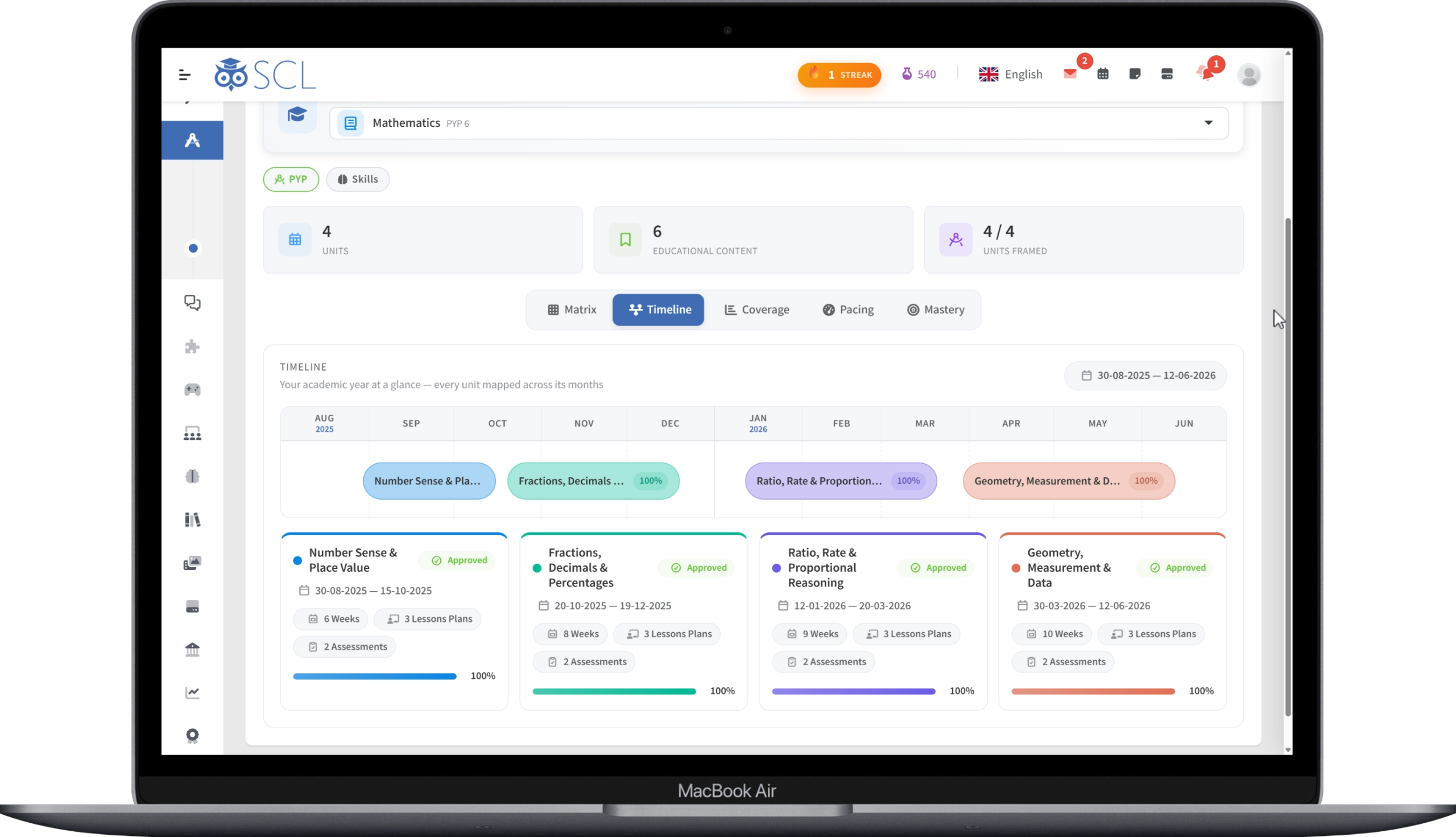
The SCL Unit Planner timeline, where a coordinator sees every Mathematics PYP unit mapped across the academic year, each unit card showing its weeks, lesson plans, assessments and approval status.

Curriculum Catalogs

01

Curriculum Frameworks

Curriculum Center ships with 48 published frameworks, from Common Core and NGSS to Cambridge, Edexcel, CEFR, ISTE and the three IB programmes. Each pairs to a school division by academic system, so a division opens on the frameworks it actually teaches.
02

Standards Catalog

Every standard belongs to a framework and sits in a programme, educational level and subject tree, so a large catalog stays navigable. Curated starter standards ship for Common Core, NGSS, ISTE, CEFR, England's National Curriculum, IB DP and the Egyptian National Curriculum.
03

Subject Objectives

IB schools plan against subject objectives: MYP's Criterion A to D, the DP assessment objectives, PYP's subject expectations. Fill a subject's objectives in one click from ready-made MYP, PYP, DP and British Key Stage 3 packs, each objective carrying its own strands.
04

ATL Skills

The Approaches to Learning catalog covers MYP, PYP and IB Diploma, organized into the five IB categories and their clusters. Seed a division from a ready-made pack, or upload your own JSON pack and export it back out for another school.

Unit and Lesson Planning

05

Unit Planner

Heads of department design each unit with its Understanding by Design framing, the standards it aligns to, its lines of inquiry and its resources. Duplicate a unit as a fresh draft, or export it to PDF for a review meeting.
06

Conceptual Catalog

All 16 MYP key concepts, 6 global contexts, 6 PYP transdisciplinary themes and the 10 learner profile attributes come preloaded. Units draw on that list rather than typed-in text, and schools can rename, reorder, retire or add their own.
07

Lesson Planner

Teachers build each lesson from named sections, budgeting every activity against the lesson's length and ticking them off as they teach. Where the AI service is switched on, it can draft those activities from the unit's own standards, objectives and concepts.
08

Review and Approval

Units and lesson plans are submitted for review and approved by a head of department, with the subject's other heads notified. Comment threads sit on the unit itself, so the conversation lives beside the plan instead of in email.

Coverage and Mastery

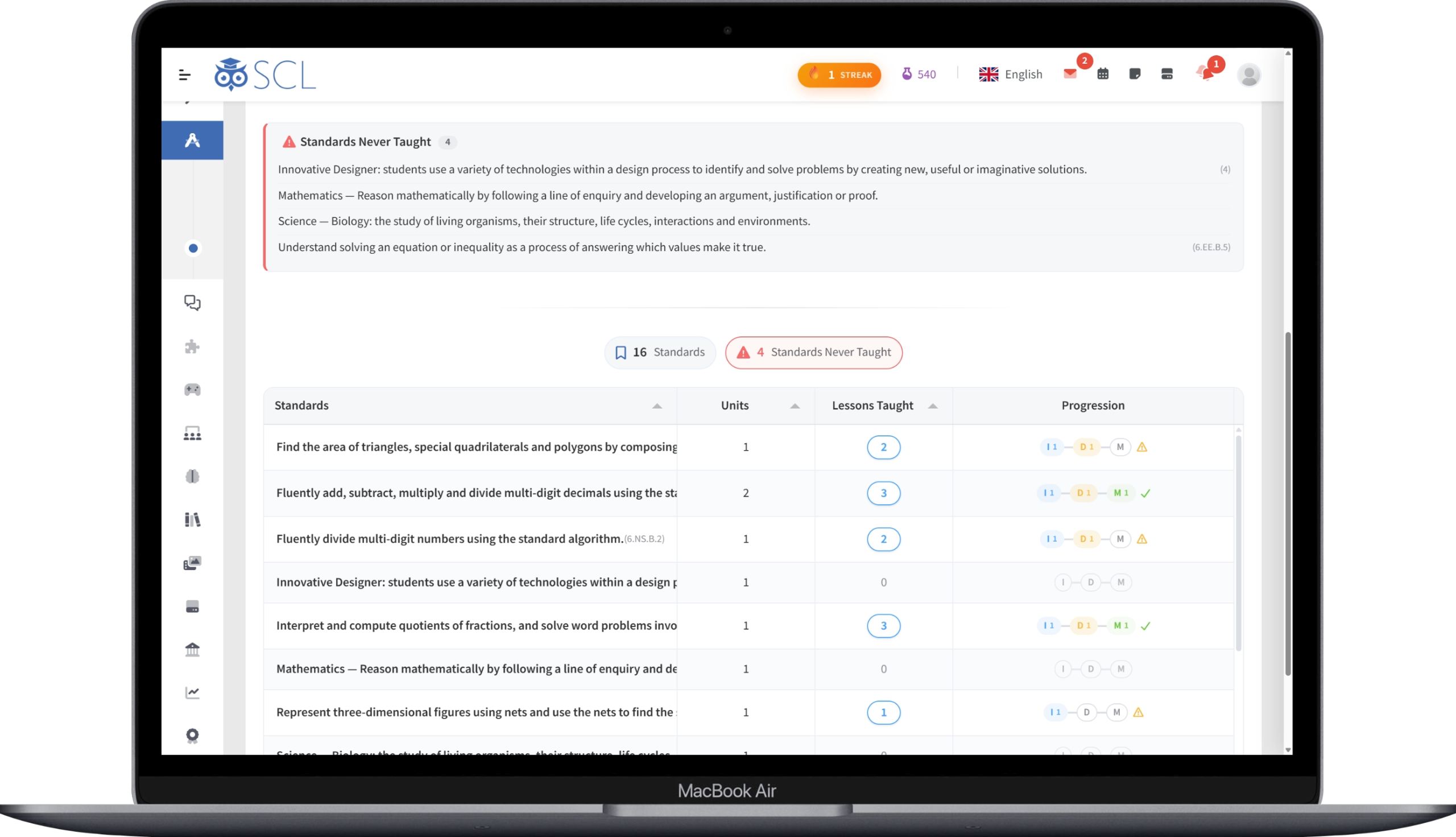
The SCL Unit Planner standards coverage view, listing each standard with the units targeting it, the lessons that taught it and its Introduce, Develop and Master progression, with standards never taught flagged on top.
09

Coverage Analytics

Coverage names the standards never taught and the ones over-taught, the skills never developed and the ones over-emphasized, mapping each against an Introduce, Develop, Master progression. It reads the shape of the teaching, including anything mastered without an introduction.
10

Pacing

Pacing compares the lessons a unit expected against the lessons actually taught, with a completion percentage and an On Track, Behind, Stalled or Complete status. The expected figure comes from a school-wide default, or a pinned override on the unit.
11

Standards Mastery

For every standard, see how many summative assessments covered it, the class average, formative results alongside and the date it was last assessed. Standards never summatively assessed are called out first, and every one drills down per student.
12

Carried Into Next Year

Promoting to a new academic year copies each unit in full: its framing, standards, skills, concepts, inquiry lines and resources all travel. Every unit arrives as a draft, so next year's plan goes through review again rather than being assumed.