
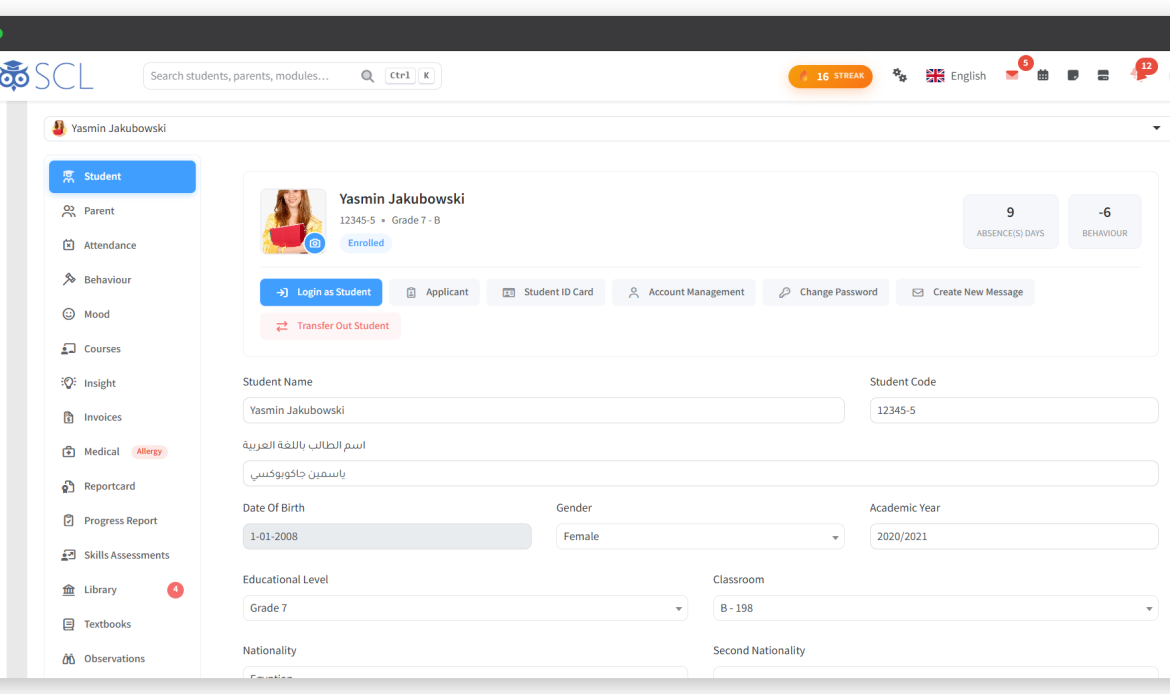
Most guides to choosing a student information system are written for schools in North America or the UK. They are useful up to a point, and then they stop being useful, because an international school in Cairo or Alexandria has a set of requirements those guides never consider.
This is a practical list of what actually matters here, written from working with schools in Egypt and the wider region. We build SCL, so we have an obvious interest, and we have tried to write this so it is worth reading even if you buy something else.
1. It has to handle more than one curriculum at once
This is the requirement that catches most international platforms out.
A large number of schools in Egypt run two or three programmes in the same building. An American diploma section alongside a national section. A British section running IGCSE while the primary years run the IB PYP. Sometimes all of it, split by division, sharing a campus, a bus fleet and a finance office.
A system built for a single national market usually assumes one grading scheme, one report card format and one academic calendar. Schools then discover the limitation in November, when the first reports are due.
What to ask: can two divisions in the same school year use completely different grading scales and different report card templates, at the same time, without a workaround? Ask to see it, not to hear about it.
For reference, SCL ships report card templates for American K-12, British and IGCSE, IB PYP, MYP and Diploma, and the Egyptian national programme, and a school can run several of them concurrently across divisions.
2. Arabic matters, and not only for parents
Even in an English-medium international school, a meaningful share of parents will read Arabic more comfortably than English. Some of your administrative staff will too.
There is a real difference between a system that can display Arabic content and a system whose own interface is available in Arabic. The first lets you type Arabic into a text box. The second lets a parent navigate the app in their own language.
What to ask: is the interface itself translated, or only the content fields? Can each user choose their own language, or is it set once for the whole school?
SCL’s interface is available in five languages including Arabic, chosen per user.
3. Fee structures here are not simple
Tuition in Egyptian private schools is rarely one number paid once. Expect instalment plans, sibling discounts, staff-child rates, separate charges for buses and activities, and a bus fee that depends on which zone a family lives in.
Many international platforms treat billing as a light add-on, or assume a payments processor that does not operate here. That leaves the finance office running the real system in a spreadsheet, which defeats the purpose.
What to ask: can it handle instalments, per-student discounts and a transport charge that varies by route, all on the same invoice? Which payment gateways does it support in Egypt specifically? Ask for names.
In SCL, fees are charged to the student record itself, so a bus place assigned in transportation bills alongside tuition rather than being chased separately, and a student who transfers out through the registrar stops being billed automatically.
4. Parent communication has to reach people where they are
Egyptian parents are reachable. They are just not reliably reachable by email.
A system whose entire notification strategy is email will produce a school that believes its parents are disengaged. In practice the parent never saw the message. Push notifications to a phone app, and SMS as a fallback, do far more work here than email does.
What to ask: does a real mobile app exist for parents, on both iOS and Android, or is it a website that resizes? Can a parent with three children at the school see all three in one login? Can each family choose which notifications they get?
5. Check what happens at the end of the year
This is the least glamorous question on the list and one of the most important.
Every school promotes its students a grade each year. In a weak system this is a manual rebuild: new classes created by hand, students reassigned one at a time, and last year’s records stranded somewhere you can no longer easily reach.
What to ask: show me the year rollover. What carries forward, what has to be recreated, and can I still pull a transcript covering a student’s whole time at the school afterwards? A transcript that only covers the current year is not a transcript.
6. Where does the data live, and who holds it
Schools here are increasingly asked this by boards and by parents, and the honest answer varies a lot between vendors.
What to ask: is this a shared multi-tenant service or does our school get its own deployment? If we leave, what exactly do we get back and in what format? Who at the vendor can see our student records?
SCL runs as a per-school deployment rather than a shared tenancy, which is the model most boards here are comfortable with.
7. Support in your timezone, in your language
A platform headquartered eight timezones away will answer your ticket tomorrow. That is fine for a cosmetic issue and genuinely painful on the morning report cards are due.
What to ask: what are your support hours in Cairo time? Do you have Arabic-speaking support? During implementation, who is our named contact and are they in this region?
8. Ask about the migration before you sign
The single biggest risk in changing systems is not the new system. It is the year of records sitting in the old one.
What to ask: who does the migration, what does it cost, how long does it take, and what happens to historical grades, attendance and financial records? Get the answer in writing. A vendor who is vague here will be vague in April.
A short checklist
Print this and take it into the demo:
- Two divisions, two curricula, two report card formats, same school year. Show me.
- Interface in Arabic, chosen per user.
- Instalments, sibling discounts and zone-based bus fees on one invoice.
- Named payment gateways that work in Egypt.
- Parent mobile app, one login for all their children, per-family notification settings.
- Year promotion demonstrated end to end, with historical records intact.
- Deployment model and data ownership, in writing.
- Support hours in Cairo time, Arabic-speaking staff.
- Migration scope, timeline and cost, in writing.
- Which modules are separately licensed. Ask before the quote.
Where we come into it
SCL is built for this market. It is one system rather than a suite: the student information system and the learning management system share one database, so marks entered by a teacher are on the student’s record immediately and report cards are generated from them rather than rebuilt from an export. Schools running IB programmes alongside national or British sections are a normal case here, not an edge case.
We do not publish a price list, because a school of four hundred and a group running four campuses are not the same conversation. If you want a figure for your school, or just want to test the list above against a real system, book a demo and bring your hardest question.