
Skip to the content

Learning Management System

A Learning Management System That Knows Your Students

Most schools run a learning management system alongside a separate student information system, then spend the year keeping the two in step. Rosters drift. A student moves class in one and not the other. Marks are exported, reformatted and imported again.

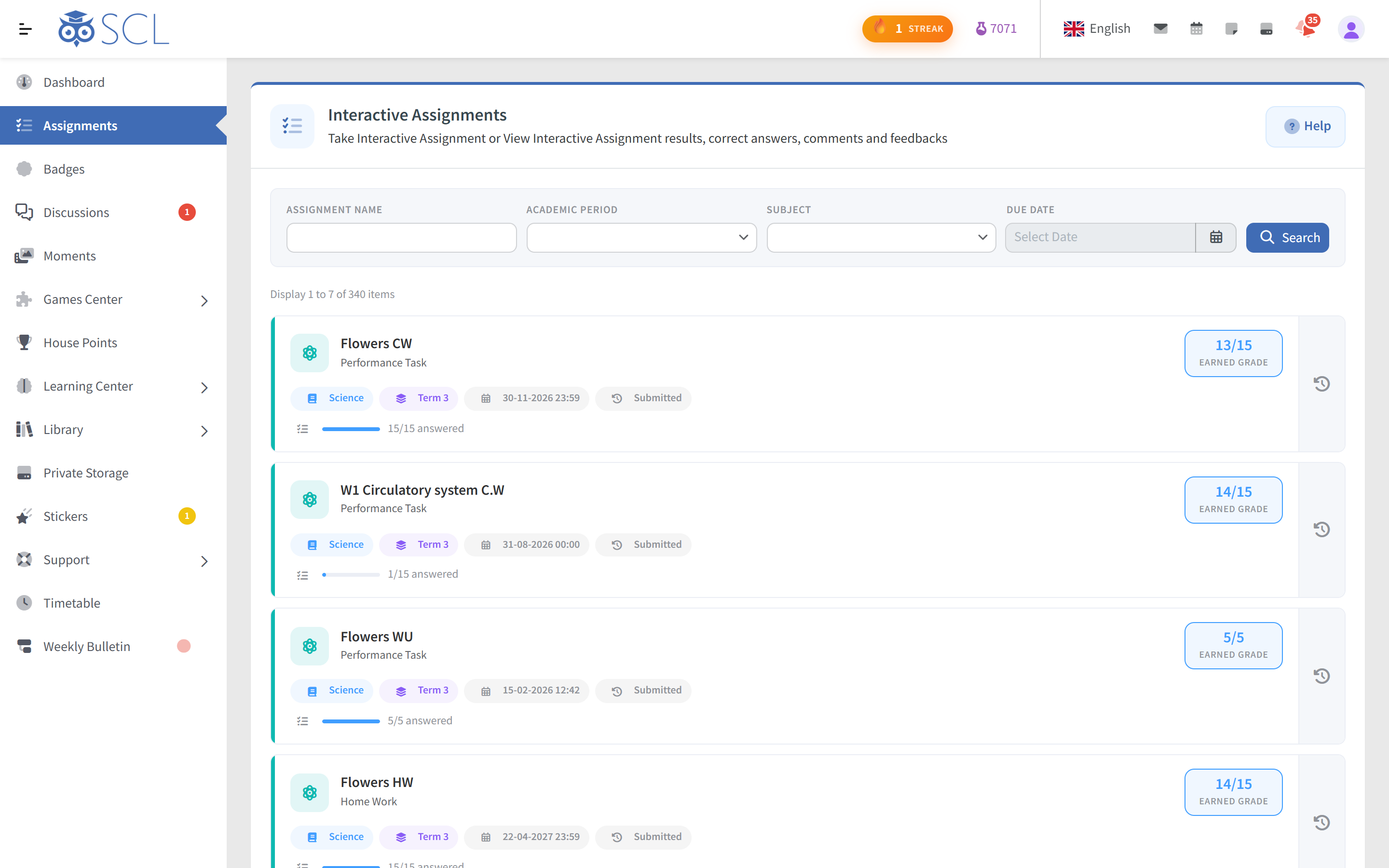
A student's interactive assignments in SCL, each with the subject, term, due date, progress through the questions and the earned grade, with search and filters.

SCL is one system. The LMS and the SIS share a single database, so the class list a teacher sees is the enrolment the registrar made, and a mark entered in the gradebook is already on the student's record. Nothing syncs, because nothing is separate.

That is what makes the rest work without extra effort. Report cards build from grades teachers already entered. Unit and lesson plans in the curriculum center connect to the assignments that assess them. Virtual classrooms take their own attendance at the door. Families follow all of it from the parent portal, and students from the student portal, on the web and on their phones.

What follows is what teachers actually use day to day, from assignments and the gradebook through class discussions and gamification to the Learning Center.

The LMS in 90 Seconds

Three People, One Place

The teacher plans the unit and each lesson against your standards, then sets the work by hand or from a draft by SCL Connect. The student answers on a laptop or a phone, closed questions mark themselves, and every mark lands in the gradebook. Parents follow the week's work and every mark in the SCL app, and reach the teacher directly.

What a Connected LMS Changes

SCL in schools streamlines education delivery, enhances communication, and fosters personalized learning. It saves time for teachers, supports collaboration, and prepares students for the digital era.

Enhanced Communication

SCL facilitates seamless communication between teachers, students, and parents. It offers features such as messaging, class discussion boards, and announcements, allowing for quick and effective communication, which is essential for clarifying doubts, sharing information, and fostering engagement.
Time-saving for Teachers

By automating administrative tasks like grading, assignment submission, and record-keeping, SCL helps teachers save time. This allows educators to focus more on planning engaging lessons, providing personalized feedback, and supporting students' academic growth.

Learning Together

SCL promotes collaboration among students through group activities, discussions, and shared projects. It encourages students to work together, share ideas, and learn from one another, fostering a collaborative and supportive learning environment.

Digital Readiness

As technology plays a vital role in today's world, using SCL prepares students for the digital era. By engaging with online platforms and digital tools, students develop digital literacy and adaptability, essential skills for their future academic and professional success.

See it in SCL

SCL Today

More Ways to Assess and Reuse Work

Eight Question Types

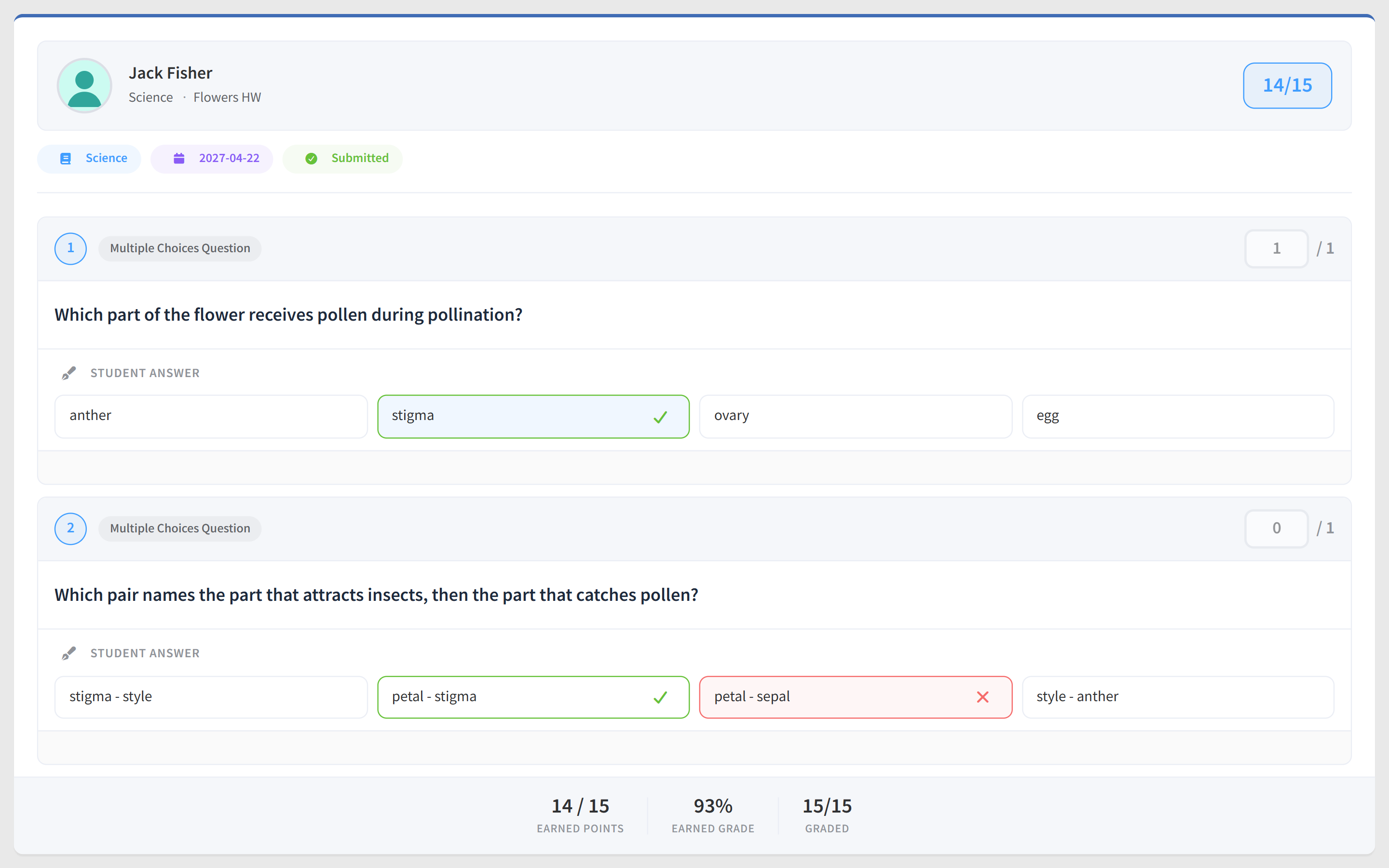
Interactive assignments mix Multiple Choices, Multiple Response, True/False, Fill The Blank, Ordering and Matching, which SCL marks itself, with written Text answers and File uploads. Teachers build the quiz the topic needs and only read what truly needs reading.

Picture Matching

Matching questions can pair pictures with words or pictures with pictures, and students join each pair by drawing a line with a mouse or a finger. Early years teachers set real assessments for children who are not yet reading fluently.

Safe Exam Browser Tests

Restrict an interactive assignment to Safe Exam Browser on Windows, macOS or iOS, so students cannot switch to another tab or application during the test. Teachers run secure assessments inside SCL without a separate exam platform. See Integrations.

Last Year's Assignments

The Assignments Copier lists a teacher's interactive assignments from earlier academic years and copies any of them, questions and all, into one or several current classes as a fresh draft. Teachers reuse what worked instead of rebuilding every quiz each year.

Share a Quiz With Peers

Share Questions exports an assignment's questions, with their answers, points and pictures, as one file that a colleague imports into their own assignment. Teachers of the same subject build a common test once and all use it.

Scheduled At-Risk Checks

Automation Tasks run a check on gradebook analytics on the days you choose, such as every student whose earned grade falls below a mark you set, and send subscribers a report to compare with earlier runs and export. Leaders see who is slipping without building the list by hand.

The Gradebook and Assignments

These features in Gradebook and Assignments within SCL significantly improve the grading process, simplify assignment management, and enhance communication between teachers and students, contributing to a more efficient and effective educational experience.

Grade Tracking

SCL allows teachers to record and track students' grades for various assignments, quizzes, exams, and other assessments.

Weighted Grading

SCL provides the option to assign different weights to various assessments, reflecting their significance in the overall grading system.

Real-time Updates

Teachers can update grades in real-time, enabling students to monitor their progress and performance continuously.

Grade Analytics

SCL offers grade analytics, allowing teachers to analyze student performance, identify trends, and intervene when needed to support struggling students.

Grade Calculation

SCL automatically calculates students' total scores based on the weighted grades, saving teachers time and ensuring accuracy.

Grade Visibility

Students and parents can access the gradebook to view individual grades, providing transparency and fostering accountability.

Assignment Creation

With SCL, teachers have the ability to create and publish assignments, providing essential details like due dates, instructions, and attachments. The system can also automate the process of autocorrection, saving valuable time for educators.

Answer Similarity Checks

SCL compares each written answer on an interactive assignment with other students' answers and tells the teacher about any match. With SCL Connect on, it also flags answers that are likely AI-written.

Assignment Notifications

When an interactive assignment opens, SCL notifies the students it was set for, with the date it is due by.

Feedback and Grading

Teachers can provide personalized feedback and grades directly with SCL, promoting constructive communication between educators and students.

Assignment Analytics

SCL provides insights into assignment performance, allowing teachers to evaluate the effectiveness of their teaching strategies and adjust their approach as needed.

Questions Bank

Teachers can create assessments quickly and efficiently. The banks enable easy reuse of questions across different quizzes and exams, saving time in content creation.

Transcripts, Report Cards and Progress

SCL contribute to improved data analysis, personalized learning experiences, and better communication between teachers, students, and parents, ultimately enhancing the overall educational outcomes.

Transcripts

Print the transcripts of a whole grade as one file, built in the background, and catch gaps first with the missing marks reports.

Skills Assessments

SCL supports skills assessments, allowing teachers to evaluate students' proficiency in specific competencies and learning objectives.

Personalized Comments

Teachers can add personalized comments and feedback for each student, providing valuable insights into their strengths and areas for improvement.

Subject-specific Reports

Customized report cards can include subject-specific grades, attendance records, and additional information relevant to each student's academic progress.

Individual Progress

SCL offers progress reports for each student, detailing their academic growth over a specific period.

Standards Mastery

Every score a teacher enters rolls up against the standards the assignment was tagged to, so a gap shows as a standard with thin evidence rather than a hunch. Teachers see it in the gradebook's Standards panel, and each student's mastery prints as a PDF.

Seamless Communication

Communication, Classrooms and Collaboration

Sending newsletters through SCL between school and parents/students. It saves time and effort, ensures targeted delivery, and enhances engagement, creating a more connected and informed educational community.

Messaging and Alerts

SCL provides an internal messaging system to facilitate direct communication between students, teachers, and other users. Notifications keep users informed about school updates, assignment deadlines, and important announcements.

Approaches to Learning

Tag an assignment with the ATL skills it develops, and the skills a student is building become visible alongside the marks. Useful in any programme, and required reporting in the IB.

Calendar and Events

The SCL calendar shows the school's events by event type, and shows Heads of Department when the units in their subjects start and end.

Virtual Classrooms

Virtual classroom features allow instructors to conduct live online classes with interactive elements, fostering engagement and real-time interaction.

Private Storage

SCL provides secure storage with the option to share specific materials with students and parents. Educators can also track students' reading time and file access, enhancing personalized learning and support.

Weekly Bulletin

Each class's week in one grid: assignments and interactive assignments flow in from the gradebook, and teachers add notes under the categories the school sets. Students and parents read it on the web and in the app.

Newsletters With Media

Newsletters go out by email, SMS or private message, with pictures, links and attached files, to parents, students, teachers or a list you choose. A private message from staff can also carry a recorded voice clip.

Newsletter Scheduling

Administrators can schedule the newsletter to be sent at a specific date and time, which is convenient for planning ahead and coordinating with important events or announcements.

Read Receipts

SCL provides read receipts for newsletters and private messages, allowing educators and administrators to see who has opened and read the messages. This feature enables them to gauge the effectiveness of their communication and identify the recipients who might need follow-up or additional support.

Foster Positive Behavior

Behavior Management

Promote a positive learning environment with our behavior module integrated into SCL. Efficiently track student behavior, encourage positive conduct through rewards, and make data-driven decisions to foster a safe and supportive school culture. Enhance parental involvement and ensure timely interventions for improved student well-being and academic success

Student Behavior Tracking

SCL allows teachers and staff to record and track students' behavior on a daily basis. This can include positive behaviors like participation, punctuality, and helpfulness, as well as negative behaviors such as misconduct, tardiness, or disobedience.

Your Behaviour Matrix

(De)merit Management holds your school's own merits and demerits, each with its points, and Response Management lists the actions staff can take on an incident. The behaviour matrix is yours, not a fixed list.

Merits, Demerits, Points

Merits and demerits carry the point values your school sets, and they add up to house points across the year. What a school does with the totals is its own call, and the record behind them is always there to justify it.

Behavior on the Record

Every merit, demerit and incident stays on the student's own record with who logged it and how it was resolved, so a pattern is visible on the profile rather than in one teacher's memory. House standings come out as their own report.

Incident Management

SCL enables the recording of behavioral incidents, including the details of the incident, the students involved, and any actions taken. This helps in maintaining a record of disciplinary actions and interventions.

Parent Communication

SCL have feature to notify parents or guardians about their child's behavior, both positive and negative. This promotes transparency and encourages parental involvement.

Gamification in SCL

Gamification in SCL refers to the practice of incorporating game-like elements and mechanics into the online learning experience to increase engagement, motivation, and learner participation. It leverages principles from game design to make educational content more interactive, enjoyable, and rewarding, which in turn enhances the learning process.

Points and Badges

Learners receive rewards from their teachers for completing tasks, quizzes, assignments, or achieving specific milestones. These visual rewards, such as points and badges, serve as a form of recognition and encouragement, motivating learners to continue their progress and active participation in the learning process.

Stickers

Teachers can award stickers to learners for various accomplishments, such as completing a course, achieving high scores in quizzes, submitting assignments on time, participating actively in discussions, or demonstrating exceptional performance.

House Standings

Points earned by students roll up to their house, and the leaderboard report shows where each house stands for the year. Schools run their own reward on top of it, in whatever form suits them.

Learning Center

The Learning Center gives students flashcards and quick reviews in the subjects your school actually teaches, drawn from a question bank organised by topic. Teachers use it in class, students use it whenever they want to revise.

Games Center

Dedicated section that incorporates educational games and interactive activities into the learning experience. It is designed to enhance student engagement, reinforce learning concepts, and make the learning process more enjoyable and effective.

Leaderboards

Leaderboards display the rankings of learners based on their performance. This element fosters healthy competition and motivates learners to improve their standings.

Effortless Integration for Students in SCL

Seamless Virtual Classrooms

SCL is founded upon cutting-edge technology that incorporates built-in virtual classrooms. This integration ensures a seamless experience within the application, making it effortless for even very young students with access to a smartphone to join their teachers with a single click, without any complexities.

Live Interaction

Virtual classrooms enable live communication between instructors and learners through various tools, such as video conferencing, chat, and audio communication. This fosters real-time interaction and immediate feedback.

Attendance at the Door

With attendance switched on for the session, students are marked present as they join, so teachers teach instead of keeping a register.

Screen Sharing

Instructors can share their screens to deliver presentations, showcase multimedia content, or demonstrate applications, making the learning experience more engaging.

Interactive Whiteboards

Every SCL virtual classroom has an interactive whiteboard to write, draw and annotate on, like the one at the front of the room.

Shared Notes

Teachers and students write together in the session's shared notes, and the teacher decides who may edit them, chat, or use a microphone or webcam.

Recording and Playback

Sessions in virtual classrooms can be recorded for future reference or for learners who may have missed the live session. These recordings can be accessed later in SCL.

Learning Center

The Learning Center empowers teachers and students by providing instant access to interactive resources, such as Flashcards and Quick Review. These tools facilitate immediate question-answer sessions, fostering an environment of active learning and on-the-spot revision.

Flashcards

Flashcards are drawn from the SCL Connect question bank and follow the topics of the subject a student is studying. Repeated exposure to the same key concepts is what makes them stick, and students can flag a card that looks wrong.

Quick Review

Quick Review delivers immediate multiple-choice questions, allowing students to test their understanding without the pressure of scoring. This approach encourages learning through immediate feedback.

Connected modules

Works Hand in Hand With

These modules share the same student record, so what happens in one shows in the others.

See How SCL Supports Daily Teaching

Walk through the gradebook, skills assessments, the questions bank and virtual classrooms with our team, and see how teaching, grading and parent communication run in one system.